Finding an amplifier circuit working with 24V DC supply is difficult. But if you get any circuit that may be complex and less power in output. In this situation I’m suggesting the Best in Best amplifier circuit, this LM1875 amplifier circuit is works with 24V battery connection with decent power output of 15 to 20W RMS.
Why Use a 24V DC Power Supply?
The LM1875 audio IC supports maximum of 50V DC power, if the IC is connected to the dual power supply it supports +/- 25V DC. The recommended input voltage in single power supply Dc voltage is 24V, it is safe. The LM1875 dual power supply amplifier circuit is best choice for home audio systems because of high power output and preamplifier, Bass treble board and filter circuits need a dual power supply same as the amp board.
When we provide the 24V DC input the output power will be ~15W RMS into 8Ω or ~20W RMS into 4Ω (with a proper heat sink). The 24V power supply is increase its lifespan and it avoids thermal and voltage stress. Use a 3A power supply or high ampere battery to powering the circuit.
LM1875 Amplifier Circuit Diagram (24V Version)
Circuit Schematic and Explanation
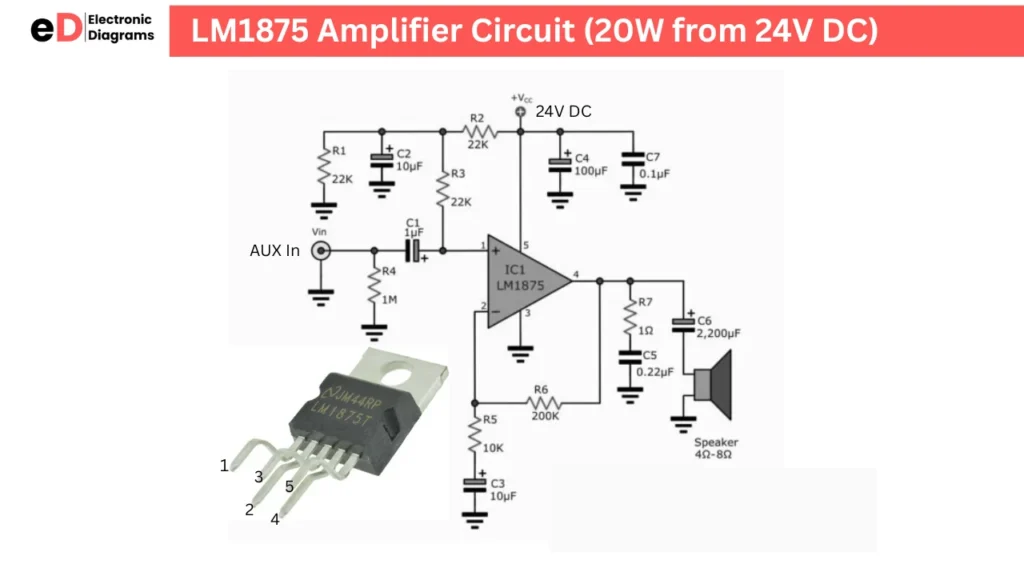
The LM1875 Pin number 4 is connected with the speaker using a series connected 2200uf electrolytic capacitor, Pin 1 is the audio input pin and Pin 2 is connected to pin 4 as feedback loop. This re the major pins of this audio IC.
A 24V single power supply is connected to the pin number 5 and pin number 3. The audio input is separated using a 1uf capacitor and 1M resistor and 22K resistors are using in both end of the capacitors and connected in negative and positive supply to maintain Low noise and input signal protection.
Capacitor C4 and C7 of 100uf and 0.1uf capacitor is used in the 12V dc supply connection for Dc filtering and it providing a smooth voltage to the IC voltage input pin, it also avoids the high frequency oscillations and Voltage noise.
List of components required
| Component Value | Reference |
|---|---|
| 22kΩ | R1, R2, R3 |
| 1MΩ | R4 |
| 2.7Ω | R5 |
| 200kΩ | R6 |
| 1Ω | R7 |
| 1µF | C1 |
| 10µF | C2 |
| 100µF | C3, C4 |
| 0.22µF | C5 |
| 2200µF | C6 |
| 0.1µF | C7 |
| LM1875 Power Amplifier IC | IC1 |
| 4Ω-8Ω, 20W | Output load |
| 24V DC | Vcc |
Notes: Use high quality aluminium heat sink for heat management. The LM1875 is produce more amount of heat if it works in its maximum efficiency, so a large haetsink is enough to cool down the IC quick. Over heating may damage the Ic and also performance.
Step-by-Step Guide to Building the Circuit
- You can test the entire circuit on a breadboard. It is not complicated because the circuit design is simple and easy to mount on bread boad. Minimum number of components is using in this circuit is the major advantage.
- While you try to build amp on the PCB over heating may damage the components, make sure that the soldering iron has the appropriate heat to quick solder.
- After complete soldering the components on the PCB, you need to test the amplifier circuit with multi meter and make sure that the output doesn’t conduct any DC output. after you check the audio with a audio frequency to identify the power of the amp.
Performance and Audio Quality
You need to consider this given below points before building this circuit, does this mach with your requirements or not.
- Power output at 4Ω and 8Ω speakers
- THD and SNR performance
- Sound quality with different sources
Troubleshooting Common Issues
- No sound output – Check IC condition and connections.
- Distortion or noise problems – Check input DC voltage and earthing issues or the noise coming from audio input or not?
Tips for Best Performance
- Proper heat dissipation is the key for the IC good working and it increase its life.
- Using quality components is very nice idea to improve its performance.
- Proper Shielding and grounding techniques will improve the performance.
Applications of LM1875 Amplifier with 24V DC
- Home audio systems
- DIY Bluetooth speakers
- Educational or lab projects